calculate working distance microscope
The numerical aperture formula defines it as. The cover slip is the thin protector cover placed over a specimen.
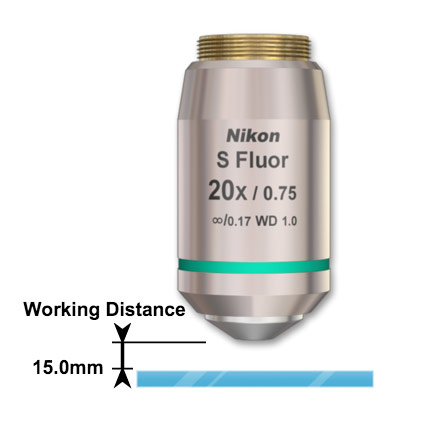
Objective Working Distance Nikon S Microscopyu
In the case of objectives designed to be used without coverslips the working distance is determined by.

. More flange focal distances can be found on Wikipedia. For microscopes that only have an eyepiece this will be enough. It is defined by the equation.
Working Distance and Parfocal Length. Maximum range where the object appears to be in acceptable focus. Im looking for some kind of equation that shows me the inverse nature between the working distance and lets say the magnification.
Divide the field number by the magnification number. Microscopes Working Distance WD The distance between the front end of a microscope objective and the surface of the workpiece at which the sharpest focusing is obtained. For instance if the eyepiece is labeled as 30x18 then 18 30 06 meaning that the diameter of for is 06 millimeters.
It decreases as magnification resolution and numerical aperture increase. In general the objective working distance decreases as the magnification and numerical aperture both increase. The calculator determines the focal length of a microscope objective given its magnification and the mechanical tube length for the finite conjugate microscopes or the reference focal length for infinity conjugate microscopes.
The stage working distance is the vertical distance. The working distance WD is determined by the linear measurement of the objective front lens to the focal plane. Assume I had two lenses with a given NA focal length and distance apart from each other.
Lens calculator Calculating the working distance a classic. Working Distance WD The distance between the front edge of the objective lens and the specimen surface with the surface of the cover glass in case of the cover glass objective lens when the specimen is focused. Rl2NA μm l055µm is often used as the reference wavelength Resolving Power R The minimum detectable distance between two image points.
Microscope objectives are usually designed with short working distances. In general the objective working distance decreases as the magnification and numerical aperture both increase. If the sensor diagonal is 20 mm and if the magnification of the objective is 20X then divide the sensor size by magnification to get a Field Of View FOV of 1 millimeter.
Working distance can range from 50 mm for dissecting or stereo microscope objectives to less than 01 mm for high-power oil immersion objectives. A f y y 1 using sensor information. The calculator can perform calculations of the third value from any two other values.
Shooting with a lens mount other than listed in the chart. How does the distance between the end of the objective lens and the specimen in an upright microscope change from low magnification to high magnification. In the case of objectives designed to be used without coverslips the working distance is determined by the linear.
As a general rule working distance decreases and total magnification increases due to the higher numerical apertures associated with high power objectives. This can be easily calculated by multiplying the pixel size by the sensor resolution number of active pixels in the x and y direction. Working distance defined Zygo The working distance is the distance from the front of the lens to the focal plane.
The Numerical Aperture is defined as the ability of a lens or grouping of lenses such as a microscope objective to collect light and resolve image details at a fixed object distance. The specified magnification on the microscope objective housing is accurate as long as the objective is used with a compatible tube lens focal length. WD MFD - mfgLL - FFD.
This size FOV is typical for microscopy applications. The working distance is the distance from the front of the lens to the focal plane. The working distance formula using flange focal distance is.
The working distance WD is determined by the linear measurement of the objective front lens to the focal plane. M L EFL. Object to lens distance where the image is at its sharpest focus.
Microscope objectives are generally designed with a short free working distance which is defined as the distance from the front lens element of the objective to the closest surface of the coverslip when the specimen is in sharp focus. Size of the camera sensors active area. In cases of specimens without cover slips linear measurement of the front lens to the specimen surface is used to calculate working distance.
Working distance refers to the space between the front lens element or tip of the microscope lens and the closest cover slip surface. The total magnification of the system is the magnification of the objective multiplied by the magnification of the eyepiece or camera tube. Microscope objectives are generally designed with a short free working distance which is defined as the distance from the front lens element of the objective to the closest surface of the coverslip when the specimen is in sharp focus.
Even when using the drop-down lists own values can be. But having an objective lens as well makes the calculation harder. Calculating the working distance using focal length object and sensor size.
Working distance is the distance between the front of the microscope objective lens and the surface of the specimen or slide coverslip at the point where the specimen is completely in focus. But Im still not sure how to even calculate the working distance of an objective with 2 lenses. A f y y 1 Note.
To determine the working distance at a focus distance other than the MFD simply plug your focus distance into the MFD value in the formula. Depth of Field DoF. The f-number of a microscope is the working distance of the objective divided by the aperture diameter.
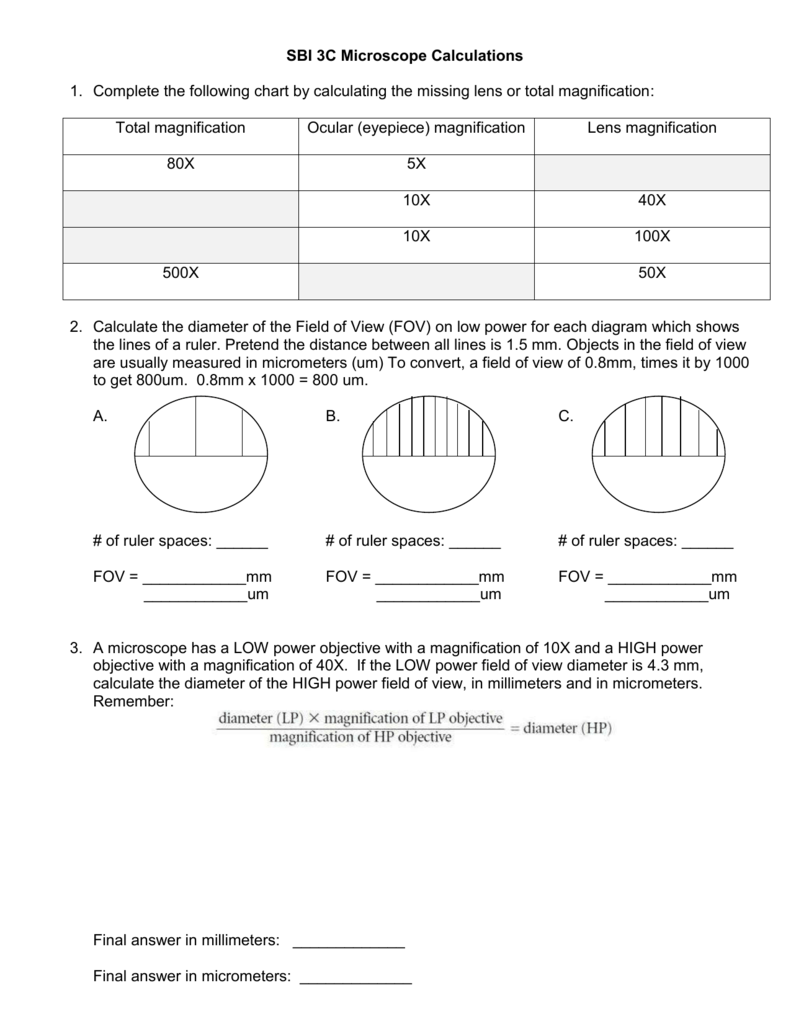
Microscope Calculations Worksheet
Microscope Calculations Field Of View Depth Of Field Numerical Aperture Dover Motion

Types Of Microscopy Microscopy Scanning Electron Microscope Biology Revision

Microscope Task Cards Kid S Love Em Task Cards Middle School Science Teacher Teaching Science

To Calculate The Resolution Of Lensfree Microscope The Distance Between Object And Sensor Is Very Small Which Equation Is Used

How To Calculate The Magnification Of A Microscope

Microscope Introduction E Lab Distance Learning Life Science Lessons Microscope Biology Lessons
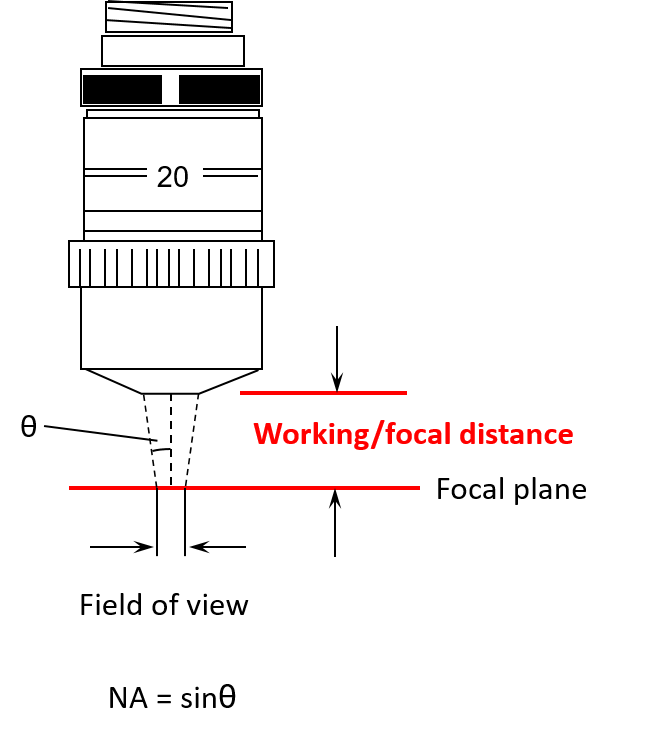
Working Distance Optical Profilometer Training

Din Standard Microscopic Optical Telescope